What is Bughouse?
Bughouse (Exchange Chess, Tandem Chess, Double Chess) is a four-player team variant. Two chess games run at the same time on Board Alpha and Board Bravo. When you capture a piece, it goes to your partner's reserve (pocket). Your partner can later drop that piece onto their board instead of making a normal move.
Bughouse Arena validates every move and drop server-side against these official rules using a dedicated rules engine built on chess.js.
Game Structure
Bughouse uses exactly two physical boards. Both teams play on both boards — one player from each team sits at each board:
- Board A (Alpha) — Team 1 White vs Team 2 Black
- Board B (Bravo) — Team 2 White vs Team 1 Black
There are no separate Board C or Board D. Four players share these two boards. Each board has its own position, clocks, and reserves. Captures on one board feed your partner's reserve on the other board.
Teams & Partners
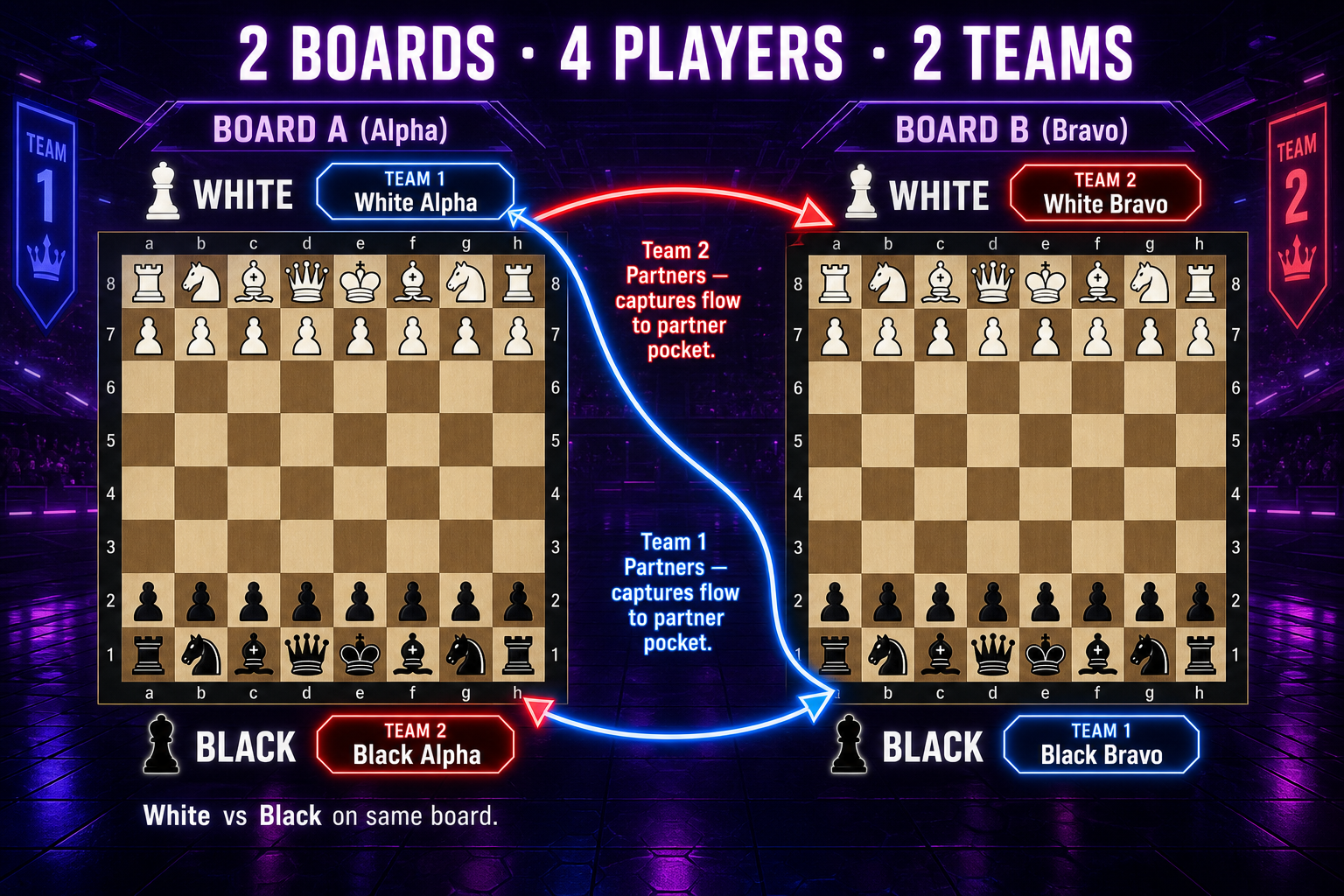
Team 1 (Blue)
- White on Board A (Alpha)
- Black on Board B (Bravo)
Partners across the two boards — never on the same board.
Team 2 (Red)
- Black on Board A (Alpha)
- White on Board B (Bravo)
Same two boards as Team 1, opposite colors.
In the arena you see your board and your partner's board. Captures you make appear in your partner's pocket instantly.
Standard Chess Rules
All normal chess rules apply on each board, validated through chess.js:
- Legal piece movement, including castling and en passant
- Check, checkmate, and pawn promotion on the final rank
- On your turn you make one action: a normal move or a reserve drop — never both
Captures & the Reserve
When you capture an enemy piece:
- The piece is removed from your board.
- Its type is determined (see promoted-piece rule below).
- That piece is added to your partner's reserve — not yours.
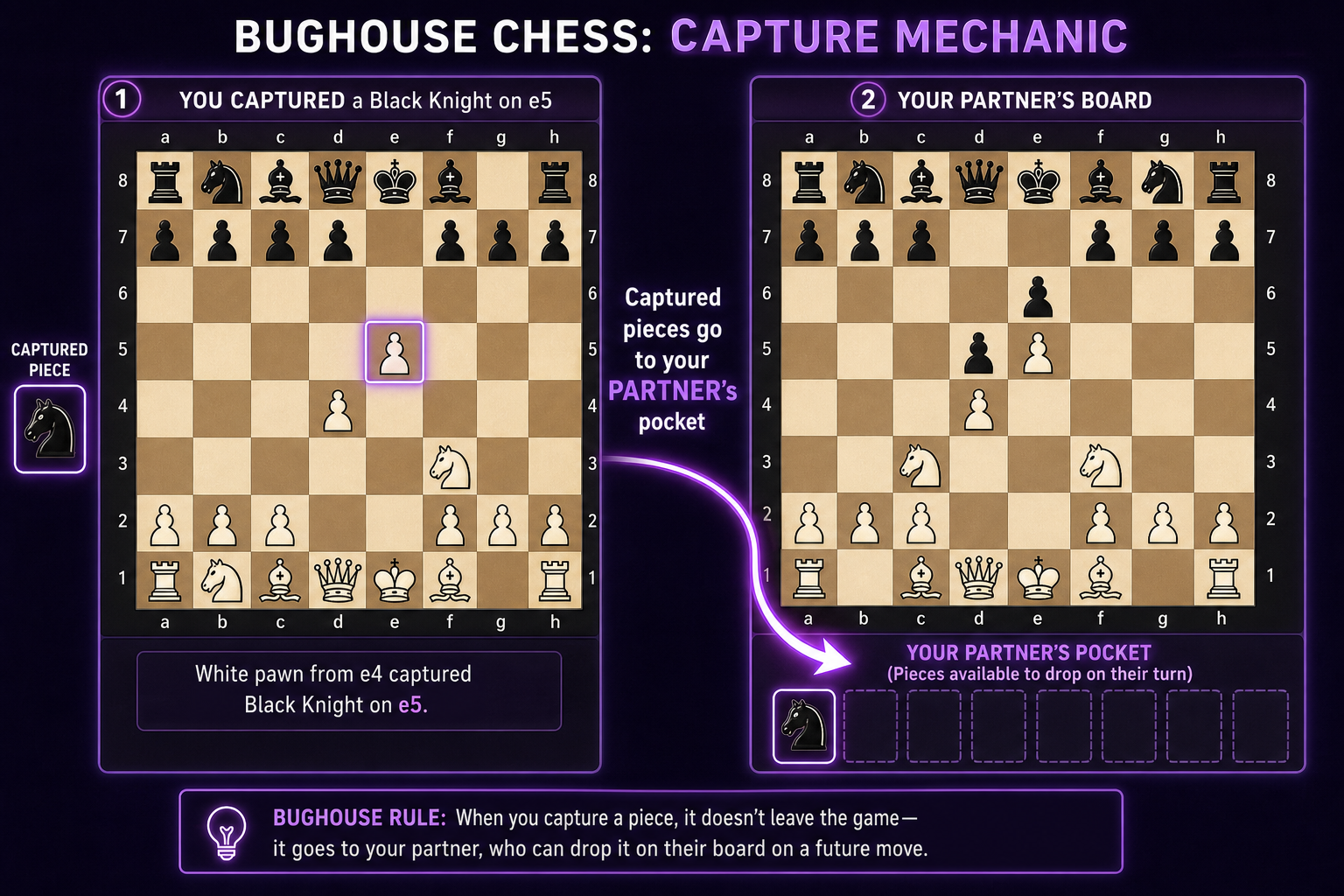
Allowed in reserve
Pawn, Knight, Bishop, Rook, Queen. Kings are never captured or stored.
Reserve integrity
Each piece exists once. Drops consume a piece from reserve. The engine prevents duplicate transfers and negative counts.
Promoted Piece Rule
Promoted pieces are tracked by square. If a promoted pawn is captured — even if it became a queen, rook, bishop, or knight — your partner receives a pawn, not the promoted piece type.
Purple = promoted queen (if captured, partner gets a pawn)
Example: a pawn promotes to queen on e8. Later that queen is captured. Your partner's reserve gains P, not Q.
Piece Drops
Instead of moving, play a piece from your reserve onto any empty square. Drop notation looks like N@f7 (knight on f7) or Q@h6# (queen drop delivering mate). A drop uses your entire turn.
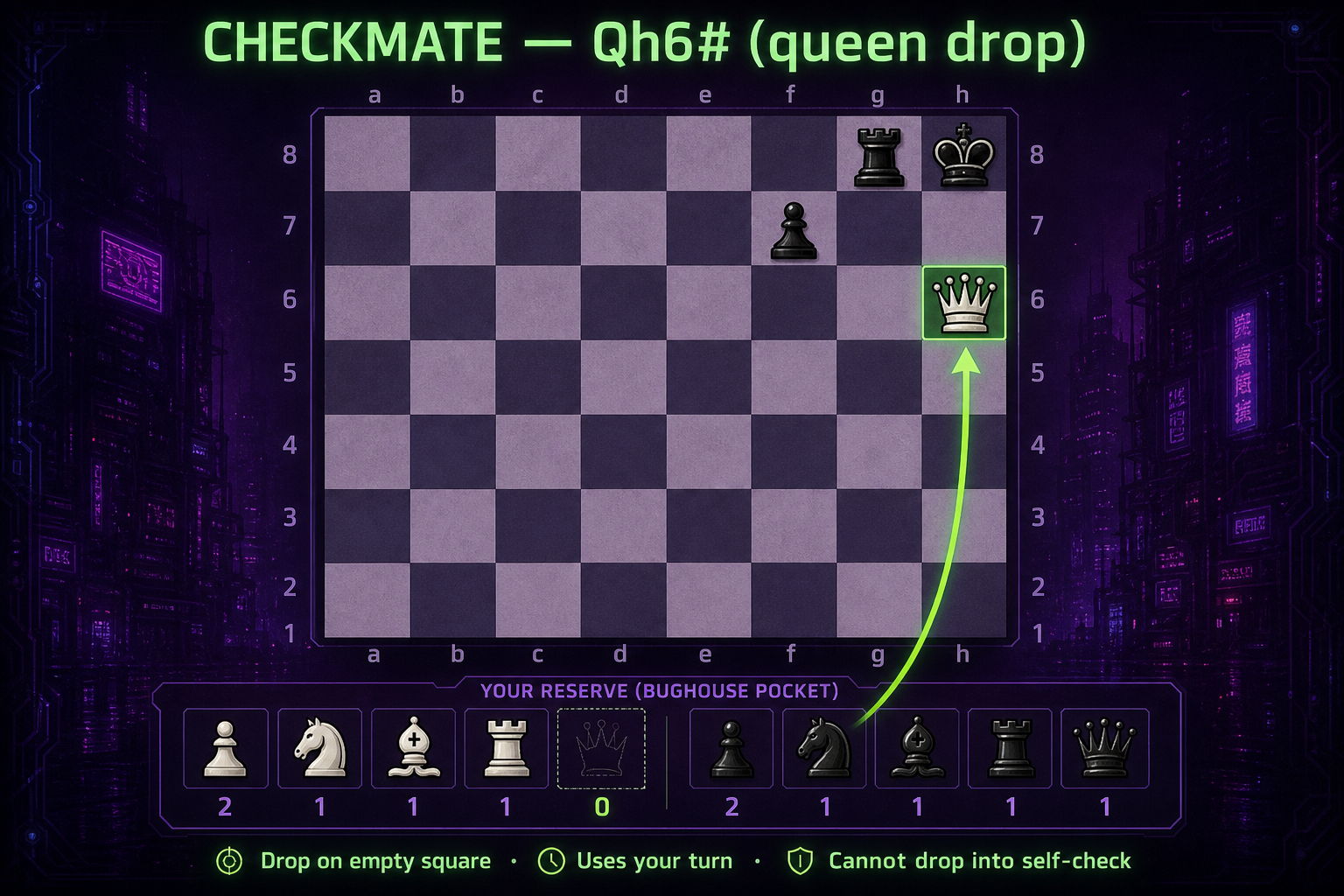
Verified engine position (green = dropped queen on h6)
Dropped pawns cannot move two squares on their first move. If a dropped pawn later reaches the final rank, it promotes normally under standard chess rules.
In Bughouse Arena: select a piece in your pocket, then click an empty square on your board.
Drop Restrictions
A drop is legal only when all of the following hold:
- The target square is empty
- You own the piece in your reserve
- It is your turn on that board
- After the drop, your king is not in check
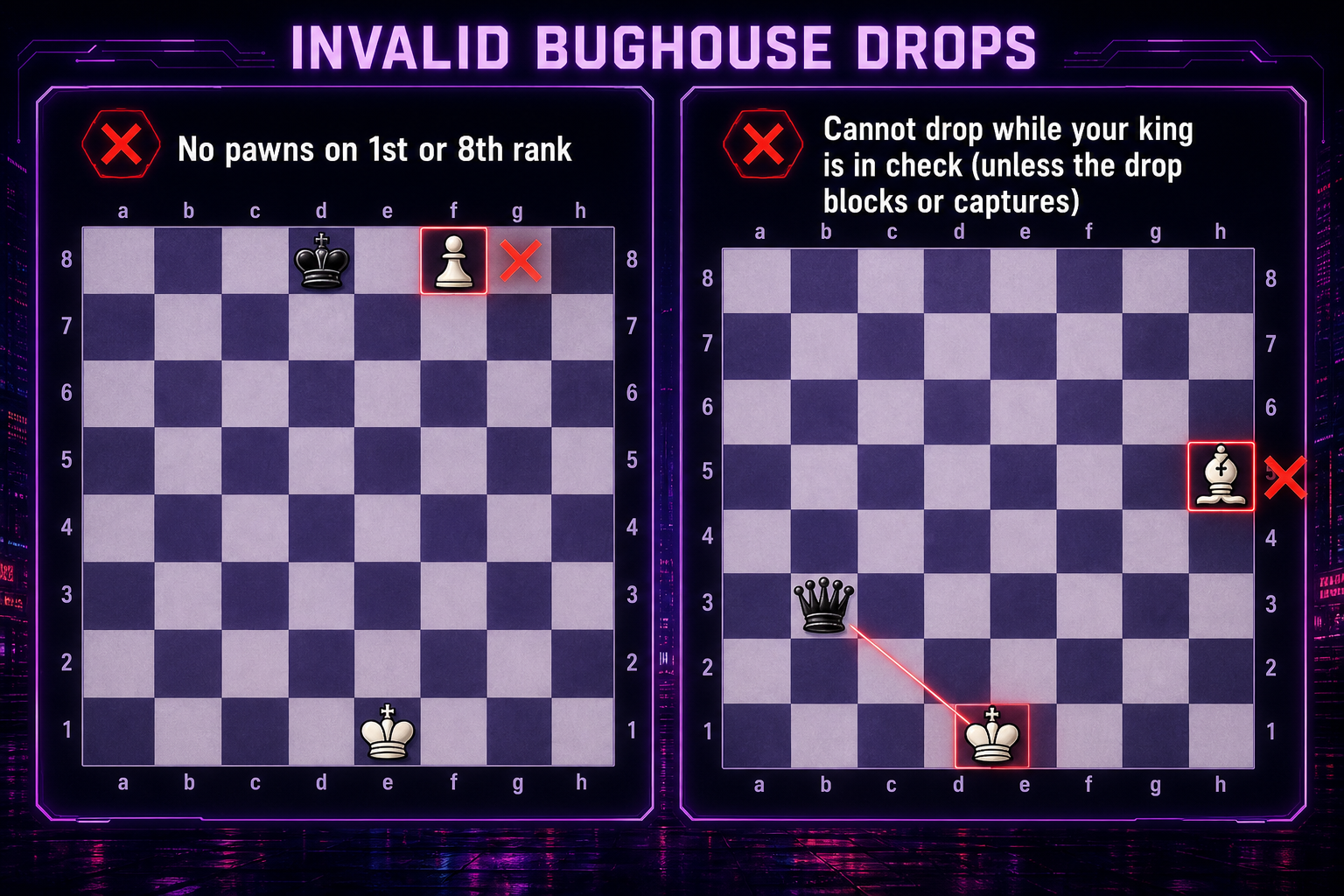
Illegal P@f8
Illegal B@h5
Legal B@d2 blocks
Check & Self-Check
A dropped piece may give check (N@f7+) or checkmate (Q@h6#) to the opponent. That is legal and often decisive.
You may never move or drop while your own king remains in check. If you are in check, you must move the king, capture the attacker, block the line, or drop a piece that resolves the check — such as B@d2 blocking the queen on c3 in the diagram above.
Checkmate & Stalemate
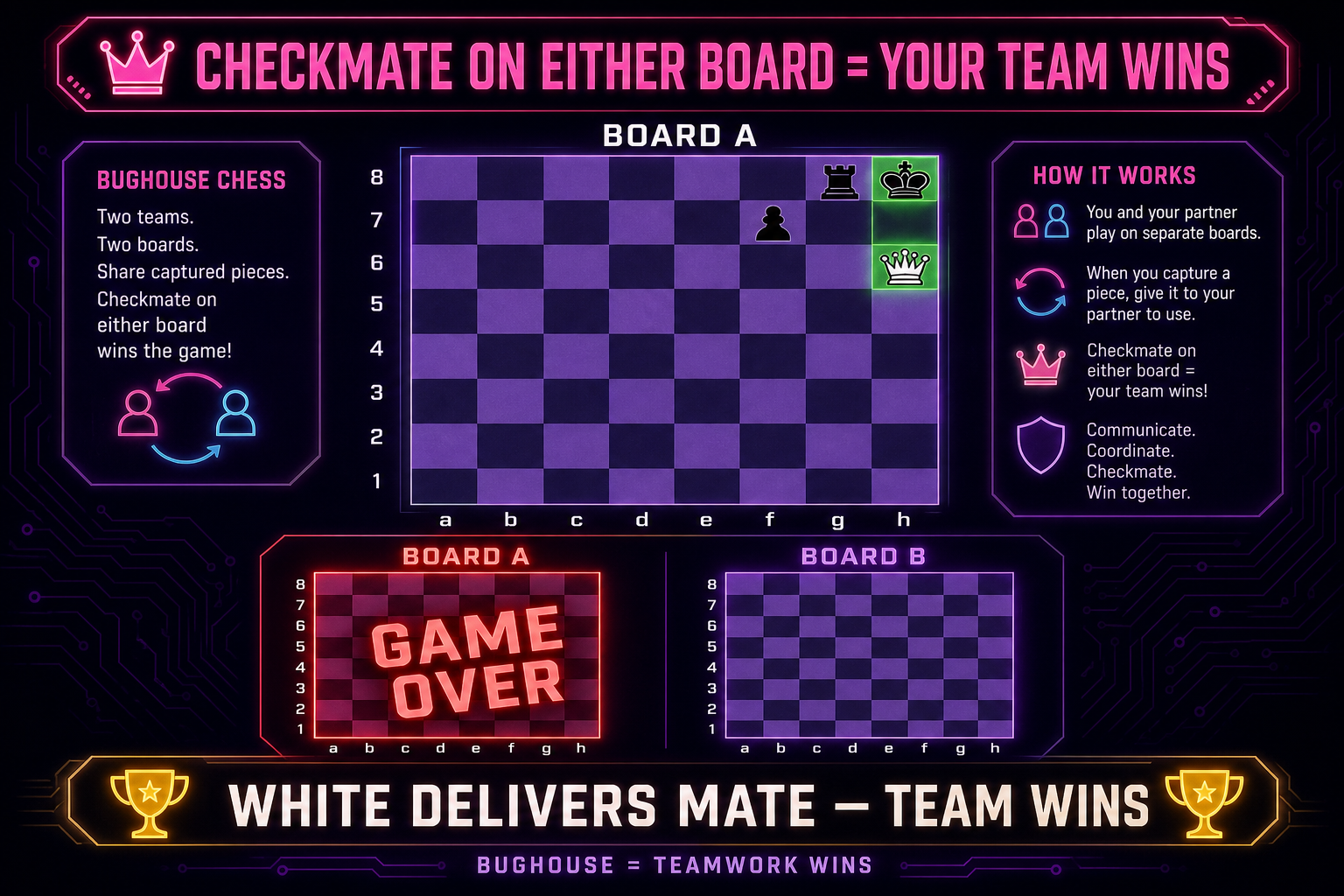
Example mate position on Board A (Q@h6#)
Checkmate
When a king is in check and has no legal move or drop, that board is checkmate. The whole Bughouse match ends at once — the mating team wins.
Stalemate (board freeze)
Stalemate occurs when the king is not in check but has no legal moves and no legal reserve drops. Only that board freezes — clocks on that board stop, no further moves or drops. The other board continues until checkmate, time forfeit, or resignation.
One board stalemating does not draw the full match. The game continues on the active board unless both boards are drawn under tournament rules.
Clocks & Sitting
Official Bughouse uses independent clocks on each board: White Alpha Clock, Black Alpha Clock, White Bravo Clock, and Black Bravo Clock. When White moves, White's clock stops and Black's clock on that same board runs — independently on Alpha and Bravo.
If anyplayer's clock hits zero, that player's team loses immediately.
When the match begins, both boards start simultaneously— White's clock on Alpha and White's clock on Bravo begin running immediately. No first move is required to start the clocks. If a player delays their opening move, only their own clock continues to run.
Sitting (legal waiting)
You may deliberately delay moving while your own clock runs — for example, waiting for your partner to capture a queen or knight before you continue. This strategic waiting is legal; you are never forced to move early.
When the Match Ends
The match ends immediately when any of these occur:
- Checkmate on either board
- Time forfeit — any player's clock reaches zero
- Resignation by any player (forfeits the whole team)
- Administrative forfeit
Playing on Bughouse Arena
Casual
Unrated games with fast queue times.
Ranked
ELO matchmaking with rank tiers from Pawn (<1200) to King (2200+).
Private
Room codes for custom four-player matches.
Built-in voice chat connects you to your partner at match start. Queue solo or party with a friend to guarantee partner pairing.
Strategy Tips
Feed with purpose
Capture pieces your partner can use — call out what is coming.
Watch both boards
Your partner's mate ends the game for you too.
Use sitting
Wait for the right reserve piece before committing on your board.
King safety
Open kings die to drops. Shelter until pocket threats are manageable.
FAQ
Can I drop a piece I captured?
No. Your captures go to your partner. You drop pieces your partner captured on their board.
What happens when a promoted piece is captured?
Your partner always receives a pawn, regardless of what the piece promoted to.
Can a drop give check?
Yes. Drops may give check or checkmate to the opponent. Only self-check is forbidden.
What if one board stalemates?
That board freezes. The match continues on the other board until a decisive result.
Bughouse vs Crazyhouse?
Crazyhouse is two-player with your own captures. Bughouse is four-player team play with partner reserves.
What is Atomic Chess?
Every capture explodes: the capturer, the captured piece, and all adjacent non-pawn pieces are removed. Explode the enemy king to win. Kings cannot capture, and you may not explode your own king.
Ready to enter the arena?
Every move is validated against these rules. Queue up and play.